 Image credit: Nakazono et al. 2026 (ApJ, submitted)
Image credit: Nakazono et al. 2026 (ApJ, submitted)
Image credit: Nakazono et al. 2026 (ApJ, submitted)
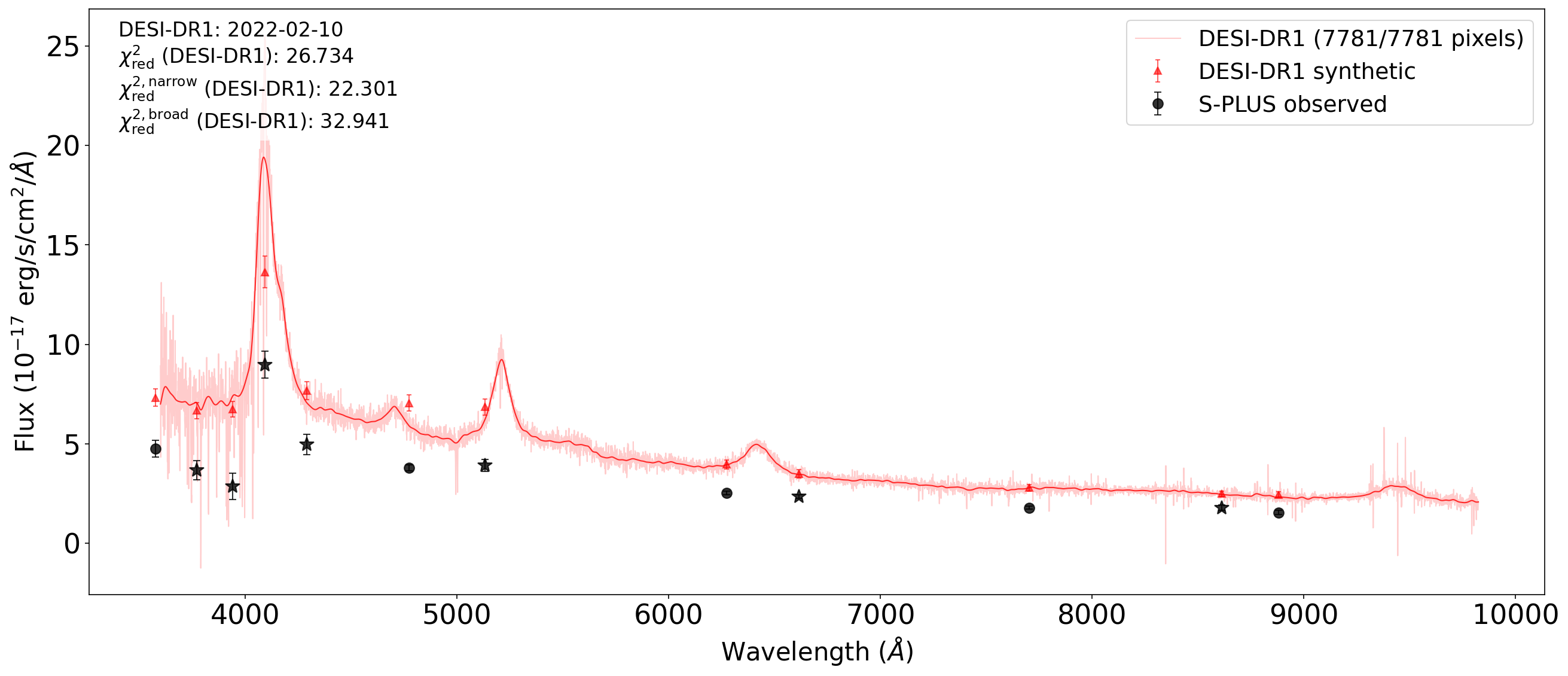
Changing-look active galactic nuclei (CLAGN) exhibit rapid spectral transitions on timescales of months to years, challenging standard AGN unification models and providing unique insight into accretion-disk variability and obscuration processes. Despite their scientific importance, systematic searches for CLAGN remain limited by the scarcity of multi-epoch spectroscopy and the difficulty of constructing large samples efficiently. We introduce CLAS+, a catalog constructed by comparing synthetic photometry derived from DESI DR1 and SDSS DR17 spectra with contemporaneous narrow-band imaging from the S-PLUS survey. Applying our pipeline to a parent sample of 98,139 quasars, we select high-confidence CLAGN candidates above a threshold of reduced chi-squared χ2r > 15. We identify 3,554 strong CLAGN candidates, corresponding to 3.6% of the parent sample. This selected fraction is conditional on the adopted criterion and should not be interpreted as an intrinsic CLAGN occurrence rate. Cross-matching with existing CLAGN compilations shows that CLAS+ identifies a large population of previously unreported high-priority candidates (3,481). Among the spectroscopic–photometric comparisons with reliable temporal classification, 40% are classified as photometric turn-on, 41% as intermediate, and 19% as turn-off. We also find an apparent redshift dependence in the relative fractions, with photometric turn-on candidates becoming more common at higher redshifts within the CLAS+ selected sample. Therefore, narrow-band photometry provides a powerful and efficient alternative to purely spectroscopic searches for identifying CLAGN candidates at scale. CLAS+ substantially expands the known CLAGN candidate population and provides a valuable target list for future spectroscopic follow-up and time-domain studies with facilities such as Rubin/LSST.
What if a supermassive black hole suddenly changes the way it accretes matter?
Changing-look AGNs (CLAGNs) are among the most intriguing examples of variability in active galaxies. They can undergo dramatic changes in their optical spectra, including the appearance or disappearance of broad emission lines, on timescales of months to years. These transitions provide a unique opportunity to investigate how accretion onto supermassive black holes turns on, shuts down, and changes state.
But finding these rare events is challenging. Traditional searches often rely on repeat spectroscopy, which is expensive and available for only a relatively small fraction of the millions of AGNs observed by modern imaging surveys.
In this work, we introduce CLAS+, a photometric approach designed to identify CLAGN candidates using the Southern Photometric Local Universe Survey (S-PLUS).
The key idea is to exploit something that makes S-PLUS particularly powerful: its seven narrow-band filters. Rather than measuring only broad colours, S-PLUS samples specific regions of the optical spectrum, including prominent AGN emission lines. By comparing observations obtained at different epochs, we can identify sources whose spectral signatures have changed significantly — even without obtaining a new spectrum.
We apply this method to a large sample of quasars and identify a substantial population of CLAGN candidates, demonstrating that narrow-band photometry can provide a complementary route to discovering changing-look phenomena.
CLAS+ opens a new window for studying changing-look AGNs:
The importance of this approach will only grow as time-domain surveys become dramatically larger. The Vera C. Rubin Observatory's LSST will repeatedly image billions of astronomical sources over a decade, creating an unprecedented opportunity to discover transient and variable phenomena.
CLAS+ demonstrates how multi-band photometry, statistical methods, and large astronomical surveys can be combined to search for rare changes in the lives of supermassive black holes.
The next generation of surveys will not simply give us more objects — they will allow us to watch the Universe change.